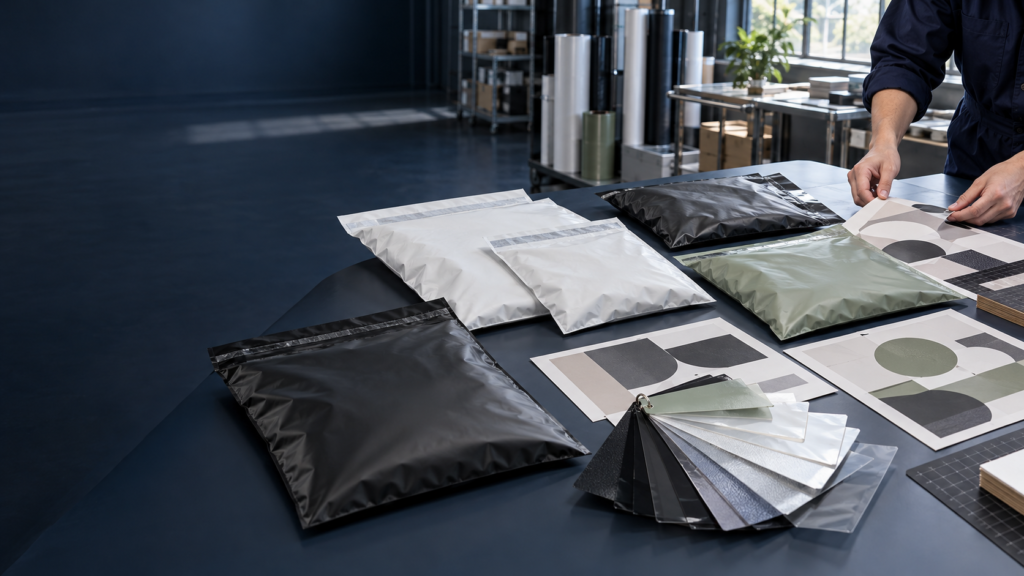
A mailing bag specification works best when it describes the finished parcel, not just a nominal bag size. Two quotations can look comparable while referring to different usable dimensions, flap lengths, materials or closure designs. A clear brief helps buyers identify those differences before approving a sample.
1. Measure the product in its packed condition
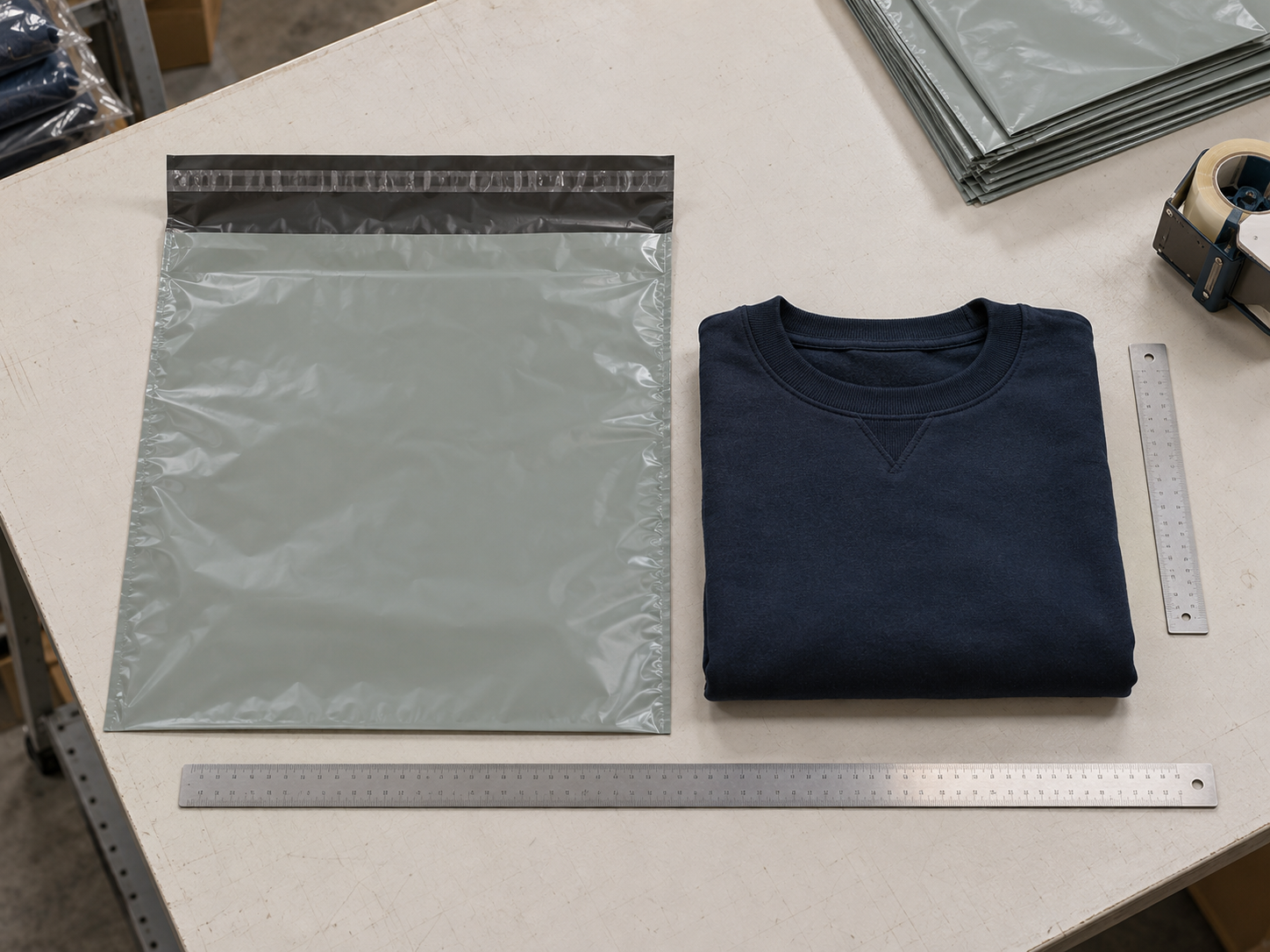
Fold or assemble the product as it will be shipped. Include any tissue, inner bag, protective box, instruction leaflet or order insert. Record the width, length and thickness of that complete pack, together with its weight.
For mixed orders, measure representative combinations. The largest item is not always the largest finished order, and a bag that fits one garment may not suit a bundle. Group regular orders into sensible size bands before deciding how many mailer sizes you need.
2. Separate usable dimensions from the flap
Ask the supplier how the stated dimensions are measured. Usable bag length and total length including the flap are different values. A quotation that lists only width × length can leave this distinction unresolved.
Product thickness also consumes space when a flat bag wraps around the contents. Allowance depends on the construction and the way the item is inserted, so a simple dimensional calculation should be treated as a starting point for a physical fit trial.
| Brief item | What to record | Why it matters |
|---|---|---|
| Packed product | Width, length, thickness and weight | Defines the item the bag must accommodate |
| Usable bag | Internal usable width and length | Avoids counting the flap as packing space |
| Flap | Length and intended sealing position | Allows the closure to reach without strain |
| Clearance | Insertion and handling allowance | Supports a practical packing process |
3. Review material and closure together
State the film composition, thickness units, colour, opacity and intended surface finish. If recycled content is required, define the target and ask what order-specific evidence is available. Recycled content and local recyclability are separate questions.
A peel-and-seal closure should be assessed on a filled bag. Check that the release liner can be removed conveniently, the flap reaches the intended sealing area and the finished pack does not place undue stress on the seams. If a returns journey is required, discuss it explicitly; a single-use closure does not automatically provide a second seal.
4. Leave room for artwork and shipping labels
Map the artwork and label area on the same layout. Seams, folds, the closure and product thickness can change how a printed graphic appears after packing. Keep important text and identifying details away from areas that are likely to be folded or covered.
- Provide the intended print position and available vector artwork.
- Agree a colour reference and the limits of a digital proof.
- Reserve a clear area for the carrier label and barcode.
- Check label adhesion on the actual proposed film.
5. Know what each sample approves
A stock sample is a reference for an existing construction. It may help assess material feel or a closure, but it cannot confirm a different size or new artwork. A digital proof reviews layout and content; it does not demonstrate the physical film or bag performance.
For a custom prototype, agree the purpose, construction and any differences from the production method. Record what is approved and what remains open. Retain the final specification, artwork version and representative sample together so the bulk order has a clear reference.
Approval is more useful when it names the characteristic being checked: fit, appearance, closure, print placement or a defined handling test.
6. Make quotations comparable
Use one brief when requesting quotations. Keep quantities by size, material descriptions, print scope, packing and delivery assumptions consistent. Ask which charges cover tooling, proofs, physical samples or transport, where applicable.
Include the destination and required receiving date. Production completion, dispatch and delivery are different milestones. Confirm them against the actual order and approval sequence rather than comparing isolated lead-time figures.
7. Retain the reference for repeat orders
Keep a controlled copy of the approved specification and artwork. Before reordering, check whether the product mix, packing method, destination, carrier requirements or branding has changed. A previous order is a useful starting point, but changes in use may require a fresh review.
Explore the mailing bag selection guide, review a self-sealing poly mailer specification, or send your packaging brief to discuss the next step.